As artificial intelligence rapidly evolves from a tool into a network of autonomous economic actors, the world faces a foundational question: How do we know which agents—human or artificial—we can trust?
We are entering an era where machines negotiate, transact, publish, collaborate, and take actions on behalf of humans and institutions. Yet the digital identity systems underpinning this new reality are dangerously unprepared.
The result is a widening trust deficit. Enterprises hesitate to deploy AI systems at scale; regulators issue increasingly urgent warnings; individuals grow more vulnerable to data exploitation; and markets remain exposed to high-frequency manipulation from opaque actors.
But a solution exists—one that preserves privacy while enabling verifiable accountability, one that works across jurisdictions and platforms, and one that can scale alongside millions of autonomous agents.
That solution is zero-knowledge proofs (ZKPs).
In this article, we explore why identity is the missing pillar of safe, scalable AI; how ZKPs create trust without surveillance; the market transformations they unlock; and why they may become the cryptographic backbone of both human and machine identity in the coming decade.
The Trust Deficit Blocking AI Progress
The global economy is on the cusp of an unprecedented transformation. Autonomous agents—software entities capable of decision-making, negotiation, and action—are becoming integral to everything from finance to logistics to enterprise automation. Yet despite their promise, they remain difficult to adopt at scale for a single reason:
We cannot reliably verify who or what these agents actually are.
The risks are substantial:
• AI agents can impersonate humans.
Without a mechanism for cryptographic identity, malicious actors can spin up thousands of convincing agents capable of fraud, misinformation, and impersonation.
• The LLM safety gap is widening.
Fine-tuned models—optimized on narrow datasets to perform specialized tasks—are 22× more likely to generate harmful or unaligned outputs than base models. Even worse, jailbreak success triples against production systems.
This means an agent interacting with a fine-tuned model cannot reliably predict its behavior or trust its guardrails.
• Autonomous agents can manipulate markets.
High-speed trading agents can spoof identities, fabricate credentials, create synthetic reputational histories, and perform unauthorized actions.
• Enterprises cannot deploy AI safely without verifiable credentials.
Every agent that interacts with financial data, health records, or critical infrastructure must prove its authorization status with certainty—not with screenshots, not with “trust me,” but with cryptographic certainty.
And critically:
In the coming decade, we won’t have one AI interface. We will have millions.
Autonomous agents will interact with one another:
- trading bots negotiating liquidity,
- logistics agents coordinating shipments,
- customer-service agents resolving disputes,
- research agents validating scientific claims.
In this coming sea of AI agents, the simple question—“Who are you?”—becomes a global cybersecurity challenge.
Without cryptographic identity verification, AI cannot safely scale.
The Broken State of Human Identity Systems
The identity crisis is not limited to machines.
Our human identity systems are equally fractured and unsafe.
The current identity infrastructure is built on:
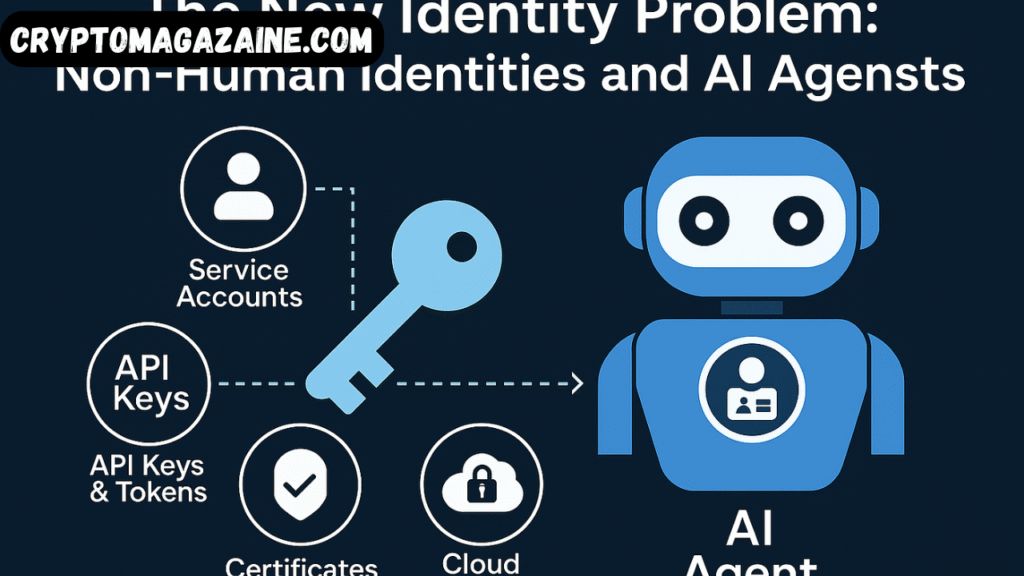
- Centralized databases filled with sensitive personal information
- Repeated document submissions across platforms
- Corporations monetizing user data without compensation
- Surveillance-heavy verification mechanisms
- A global landscape of data breaches and leaks
Each login, each KYC check, each “prove your age” request creates another vector for exploitation.
The result is hostility from both sides:
- Users don’t want to expose more personal information.
- Regulators require increasingly invasive verification.
This paradox—demand for trust vs. need for privacy—cannot be resolved with traditional identity systems.
We need a new architecture entirely.
And this is where zero-knowledge proofs change everything.
Zero-Knowledge Proofs The Bridge Between Privacy and Accountability
Zero-knowledge proofs are one of the most transformative cryptographic inventions of the last century. In simple terms:
A zero-knowledge proof allows you to prove that something is true without revealing any underlying data.
This means:
- A person can prove they are over 21 without revealing their birthday.
- An AI agent can prove it was trained on compliant datasets without revealing proprietary code.
- A business can verify a customer meets regulatory requirements without storing any personal information.
- A content creator can prove authorship without revealing identity.
- A trading bot can prove it is licensed to perform financial actions without exposing internal logic.
ZKPs provide attestation without exposure, accountability without surveillance, and verification without data leakage.
This directly solves the core problems of AI and human identity.
A Trust Graph for Machines and Humans
By storing zero-knowledge credentials on-chain in a composable trust graph, agents—both human and artificial—can:
- Prove reputation
- Prove compliance
- Prove authorization
- Prove origin
- Prove training lineage
- Prove safety parameters
all without revealing what they don’t want to reveal.
This is the missing identity layer for the machine economy.
The Composable Identity Layer: How ZKPs Empower AI Agents
For AI agents, identity is not just a name or an account.
Identity is a stack of verifiable claims, each one attesting to something important:
Technical Claims
- Model architecture
- Training dataset lineage
- Safety audit results
- Compliance checks
- Behavioral testing history
Legal Claims
- Ownership entity
- Jurisdiction of deployment
- Liability coverage
- Certification requirements
Social/Behavioral Claims
- Reputation scores
- Past performance
- Stake-weighted trust markers
With ZKPs, all of these can be proven cryptographically without revealing raw data.
This enables:
• Interoperable identity across platforms and borders
An agent trained in one country can seamlessly interact in another.
• Privacy-preserving regulatory compliance
Agents can operate within legal frameworks without exposing sensitive architecture.
• Trustless agent-to-agent interactions
Two autonomous entities can negotiate, transact, and collaborate without relying on centralized identity, corporate credentials, or surveillance systems.
Market Implications Unlocking the Agent Economy
Generative AI is projected to add trillions of dollars per year to global GDP.
Yet much of this potential remains unlocked due to identity barriers.
Institutional investors require provable KYC/AML compliance before deploying capital into AI-driven strategies.
Enterprises require robust identity before allowing autonomous systems to
- Execute transactions
- Access sensitive information
- Interface with critical infrastructure
Regulators need verifiable accountability before approving AI deployment in
- finance
- healthcare
- law
- supply chain
- public governance
Zero-knowledge identity solves all of these obstacles at once.
ZKP Identity Makes Markets More Efficient
- No sensitive data stored = no honeypots
- Selective disclosure = compliance without exposure
- Cryptographic validation = trustless interactions
- User-controlled credentials = full sovereignty
This flips the existing model.
Instead of platforms owning identity, people and agents own their identity, and platforms verify it.
Defending Reality ZKPs and the Deepfake Crisis
We are entering a world where synthetic content is indistinguishable from human-created media.
Deepfakes are already destabilizing:
- elections
- financial markets
- social networks
- journalism
- interpersonal trust
ZKPs provide a powerful, privacy-preserving solution.
Every piece of content—text image audio video could be cryptographically linked to a verified creator using zero-knowledge proofs.
This means:
- Content is authentic
- Creator identity remains private
- Provenance is provable
- Manipulation is detectable
This allows us to fight misinformation without building a surveillance internet.
The ZK Path A Future of Privacy-Preserving Identity
Critics argue that identity systems risk authoritarian control.
But identity already exists—poorly, invasively, and dangerously centralized.
Every passport check, every KYC portal, every facial scan at an airport is part of a massive identity infrastructure that we do not control.
Zero-knowledge proofs offer a better alternative
- Users control their data
- Verification without surveillance
- Proof without exposure
- Accountability without compromising freedom
- Trust without centralized authorities
This path allows us to build a digital world where both humans and AI agents:
- interact securely
- comply with legal requirements
- maintain privacy
- operate across global markets
without surrendering sensitive information to corporations or governments.
Conclusion ZKPs May Become the Backbone of the Next Digital Civilization
The world is shifting from a human-only internet to a hybrid ecosystem of humans and autonomous agents.
Identity—verifiable, privacy-preserving, interoperable identity—is the foundational layer this new world requires.
Zero-knowledge proofs provide the architecture.
A composable trust graph provides the infrastructure.
AI agents provide the momentum.
The question is not whether the world will adopt ZKP-based identity systems.
The question is how quickly we will realize that they are the only scalable path forward.
The future of the global economy—human and machine—depends on identity we can trust, without sacrificing privacy or sovereignty.
Zero-knowledge proofs are not just a technology.
They are a civilizational upgrade.