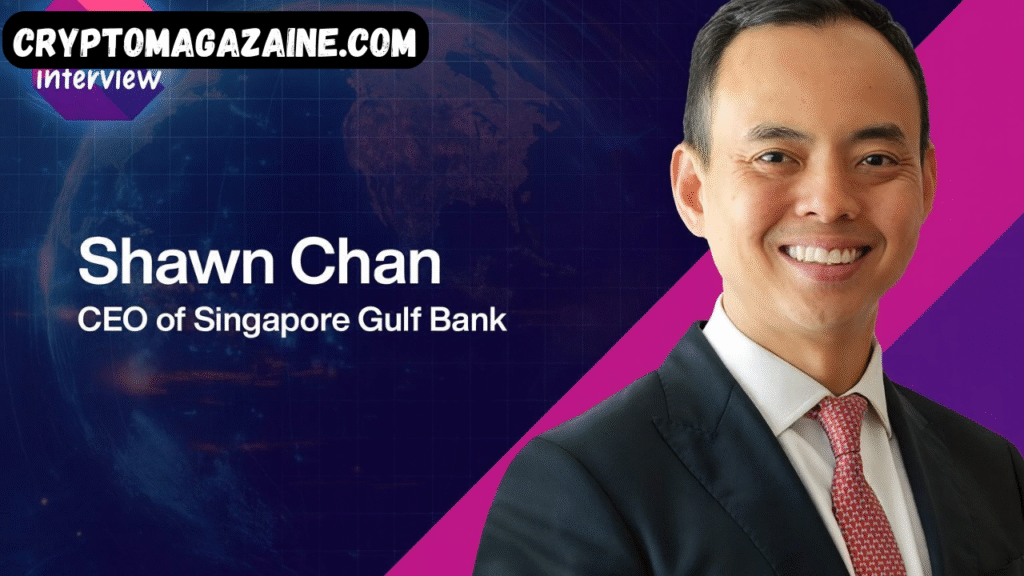
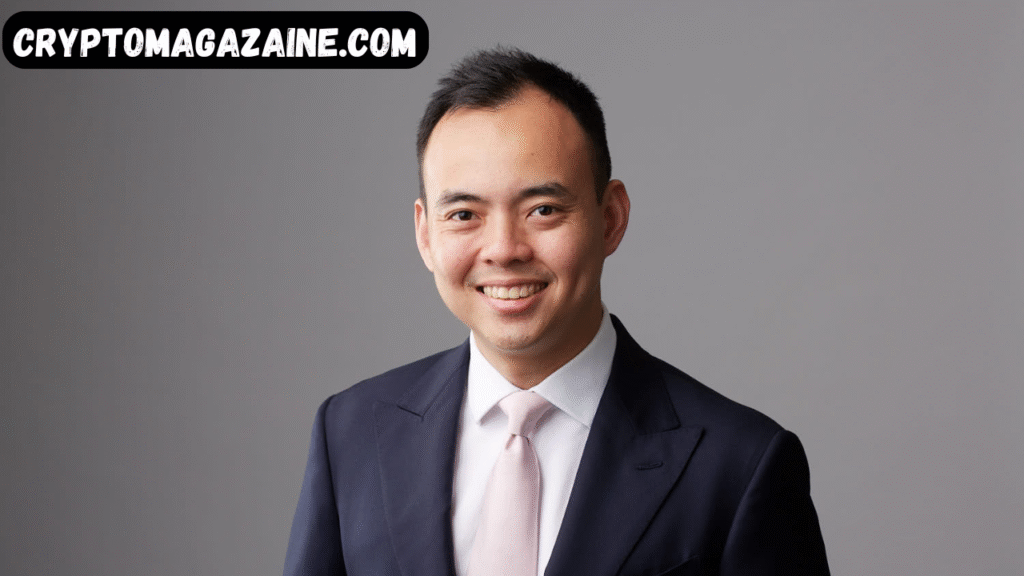
When Shawn Chan talks about the future of banking, he does so with a rare blend of legal precision, regulatory fluency, and frontier-tech intuition. As the CEO of Singapore Gulf Bank (SGB), Chan stands at the nexus of two powerful forces reshaping global finance: the digital-asset revolution and the fast-strengthening economic corridor linking Asia with the Gulf Cooperation Council (GCC) region.
In an extensive conversation with CryptoNews, Chan opened up about his unusual journey—from corporate law to building one of Bahrain’s most forward-looking digital banks. He discussed the regulatory strategy behind SGB, the rapid institutional embrace of stablecoins, and how his bank is positioning itself to serve as a bridge between traditional finance and the rapidly evolving world of Web3.
What emerged is a portrait of a banker who sees the coming convergence of financial systems not as a distant future, but as a present reality already reshaping global commerce.
From Corporate Law to Leading a Digital-Asset Bank

Before he ever imagined running a bank, Shawn Chan built a career in one of the most conservative fields imaginable: corporate law. His work revolved around corporate finance, regulatory interpretation, and compliance—disciplines that would later become unexpectedly relevant in the regulated digital-asset world.
His initiation into crypto was almost accidental.
It happened in London in 2015, when his wife, then studying financial innovation, asked him a simple question: “Have you heard of this thing called Bitcoin?” The two visited a café where a Bitcoin evangelist was speaking, and outside sat a Bitcoin ATM.
“I bought my first Bitcoin there,” Chan recalled with a laugh. “I have no idea where it is now.”
Soon after, the blockchain wave reached Singapore. By 2016–2017, as ICOs exploded across Asia, Chan found himself advising more and more crypto founders. What began as isolated client work expanded into a growing specialization. Founders needed legal clarity and regulatory guidance, and Chan—fluent in financial rules—naturally gravitated toward the center of Singapore’s early crypto industry.
His legal work eventually intersected with Whampoa Group, a private family office known for its sophisticated and ambitious approach to digital finance. Chan was initially engaged as external counsel to support a digital-bank license application in Singapore—a bid that ultimately did not succeed, but which planted the seeds for something far larger.
Why Singapore Gulf Bank Launched in Bahrain—Not Singapore or Dubai
It would have been easy to assume that Whampoa’s digital-banking ambitions would take root in Singapore or Dubai, two of the most advanced fintech hubs in the world. Instead, the team chose Bahrain.
According to Chan, the decision was driven by regulatory coherence, speed, and a shared vision with Bahraini authorities.
“One great thing about Bahrain—similar to Singapore—is that they have one super regulator,” he said. The Central Bank of Bahrain (CBB) oversees every major financial vertical: banks, capital markets, money services, and crypto-asset service providers.
This unified structure matters more than many outsiders realize. Digital banks increasingly operate across overlapping categories: retail banking, custody, payments, crypto services, and more. In countries where different agencies oversee different verticals, gaps and inconsistencies inevitably arise.
“In some jurisdictions, there might be dislocations,” Chan said. “In Bahrain, the regulator sees the entire ecosystem.”
The CBB’s clarity, consistency, and openness to innovation made Bahrain an attractive launching ground for a bank built to operate at the frontier of digital finance.
Building a Bank for Two Universes—Traditional and Web3
Although SGB carries “Singapore” in its name, its mission is global. The bank was licensed in Bahrain with a specific objective: to operate across borders with a strategic focus on the Asia–GCC corridor, one of the fastest-growing trade routes in the world.
What makes SGB unusual is that it is designed from day one to serve both crypto-native clients and traditional finance clients. For years, these two groups existed as separate universes. One lived inside the blockchain economy, transacting at the speed of code; the other remained firmly anchored in conventional banking systems and compliance frameworks.
Chan believes those boundaries are dissolving.
“There is a very strong sense of being compliance-first—prioritising security and compliance,” he said. “That is not incompatible with innovation.”
He credits improvements in wallet analytics, blockchain forensics, and AML/KYC tooling for making digital-asset banking safer and more practical than ever. Tools that barely existed five years ago—chain-monitoring systems, risk-scoring engines, and counterparty analytics—are now industry standard.
“You can never be 100% sure,” Chan acknowledged, “but today is a much better time to do this business than before.”
The regulatory environment has also matured considerably. More jurisdictions now provide clear crypto regulations, creating harmonised standards for banks. The global compliance puzzle, while still complex, looks increasingly solvable.
Partnerships with Binance and Fireblocks Integrating the Crypto Economy into a Bank
Few banks in the Middle East openly partner with the world’s largest crypto exchange. SGB does.
Through its “SGB Link” integration with Binance, SGB allows clients to open and fund Binance trading accounts directly within the bank’s ecosystem.
“If an SGB client wants a Binance account, they can work through us,” Chan explained. “You can directly debit your dollars from the SGB account and fund your crypto trade in Binance.”
The reverse is also true: crypto proceeds can flow back into a regulated SGB bank account. The experience is seamless, compliant, and designed for both retail and institutional users.
SGB also collaborates with Fireblocks, one of the most trusted digital-asset custody and wallet-infrastructure providers in the world. Fireblocks powers the backbone of SGB’s forthcoming digital-asset services—products that will roll out after regulatory approvals are secured.
Together, Binance and Fireblocks position SGB as one of the region’s most crypto-integrated banks.
Stablecoins Are Redefining Global Payments—Faster Than Anyone Expected
Perhaps the most eye-opening part of Chan’s interview was his assessment of stablecoin adoption.
In his view, stablecoins are not simply emerging—they are already transforming global payments.
He described the trend bluntly: “Adoption is 100% happening.”
Many expected that early SGB clients would be crypto traders or digital-asset companies. Instead:
“Close to half of our clients are from the traditional payments industry.”
These clients span cross-border merchants, trade finance operators, and payment companies. Many of them settle international payments between Asia, Africa, the Middle East, and Latin America—regions where correspondent banking can be slow, expensive, or unreliable.
Stablecoins solve these issues.
Transaction speeds become predictable. Settlement costs fall. And liquidity becomes global.
Perhaps most surprisingly, according to Chan, many merchants don’t even know stablecoins are being used in their payments. Payment processors simply route using the fastest and most efficient rails—often via stablecoins—without exposing the complexity to end-users.
The shift is so widespread that card networks have begun experimenting with stablecoin settlement at scale.
Chan sees this as a watershed moment:
“The direction is clear. The impact we have to see. It’s definitely going to be big.”
When the world’s leading payment processors start exploring blockchain-based settlement, it signals profound and irreversible change.
Positioning for the Next Wave SGB’s Strategic Vision
Looking ahead, Chan envisions SGB becoming one of the major players in the Asia–GCC digital finance ecosystem. The bank aims to serve as both a gateway for institutional crypto activity and an engine for real-world commerce moving across regions.
“Our ambition is to be the top player in this space,” he said.
That means enabling:
- cross-border trade settlement
- institutional stablecoin adoption
- frictionless fiat–crypto bridges
- digital-asset custody and wallet services
- compliant on-ramps and off-ramps for global platforms
- financial infrastructure for merchants, SMEs, and payment companies
- deeper integration between Asian and Gulf financial systems
For Chan, whose first encounter with Bitcoin happened outside a London café a decade ago, the evolution of the industry feels inevitable.
Blockchain is no longer a fringe idea; it is merging with the global financial system in real time. And as Asia–GCC trade flows surge, Singapore Gulf Bank is positioning itself at the intersection—connecting economies, bridging technologies, and unifying the once-separate worlds of traditional finance and Web3.
The digital-asset revolution is not coming.
It is here.
And SGB intends to be one of the institutions defining what the next era of global banking looks like.