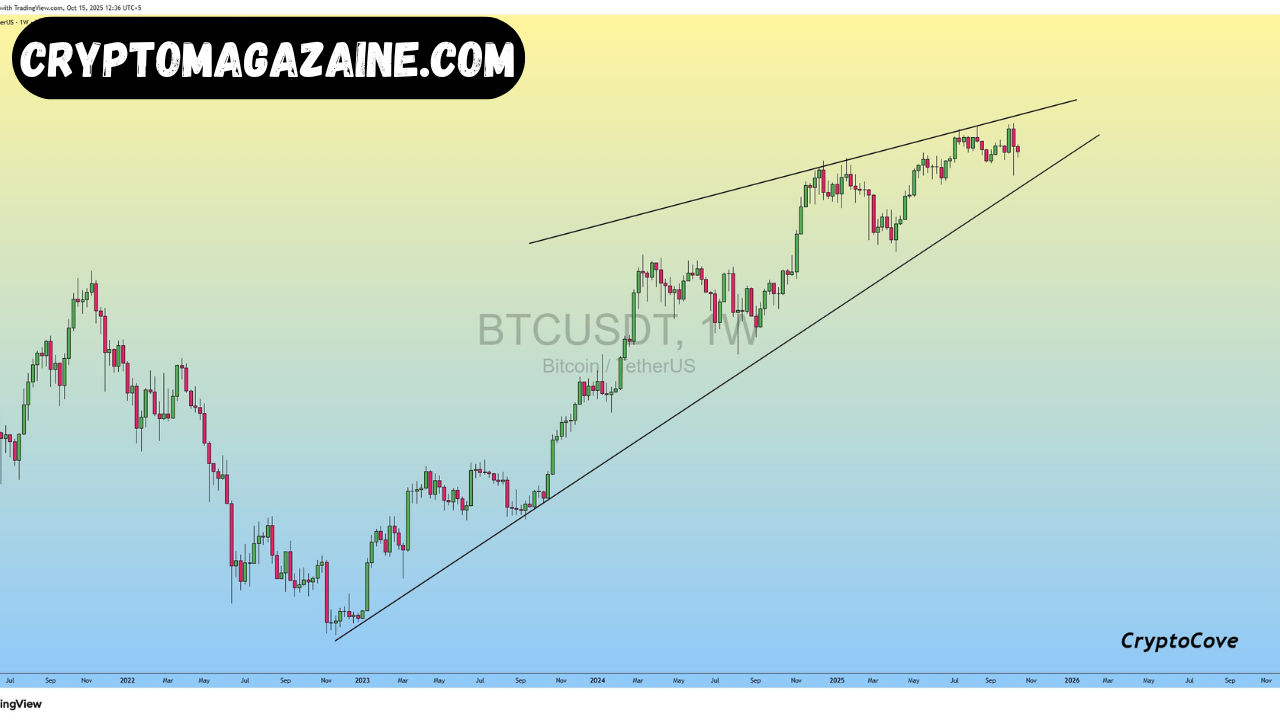
After a turbulent October, Bitcoin finds itself navigating a delicate phase of consolidation, with prices hovering near $110,000. The cryptocurrency’s trajectory in November will be influenced by a complex interplay of macroeconomic data, investor sentiment, and the ongoing flow of capital into Bitcoin exchange-traded funds (ETFs). While the community debates whether the recent correction signals the end of the bull cycle, many analysts see the current price action as a necessary market reset rather than a terminal decline.
October’s Correction Shakeout Without Structural Damage

Bitcoin closed October following a sharp correction, moving in tandem with the broader cryptocurrency market. On Oct. 10, BTC experienced a rapid selloff that briefly tested lower support levels, generating widespread concern among traders and investors. Despite the intensity of the correction, Bitcoin did not suffer structural damage. The coin’s resilience has been evident in its ability to rebound each time it nears the lower end of its current trading range, suggesting that support remains intact.
The asset has since been consolidating between $105,000 and $116,000, reflecting a balance between selling pressure and buying interest. This range-bound movement has been likened to a “ping-pong” game, where dips toward $106,000 are consistently met with recovery attempts toward $116,000. Analysts argue that this consolidation is not a sign of a broken bull market but rather a necessary phase in which the market recalibrates after a sharp correction.
Cais Manai, Co-Founder and Head of Product at TEN Protocol, described the current market structure as a “mid-cycle reset.” According to Manai, a temporary pullback could precede a more substantial rally if macroeconomic conditions and liquidity flows align favorably.
Institutional Flows Cautious but Committed
Institutional investment continues to play a defining role in Bitcoin’s market dynamics. October began with a wave of ETF inflows, with some days exceeding $1 billion. This bullish momentum, however, was abruptly interrupted by the mid-month correction, which triggered $4.5 billion in net outflows from Bitcoin ETFs—a significant event highlighting the fragility of sentiment-driven rallies.
Since that selloff, inflows and outflows have stabilized, creating a delicate equilibrium. Market observers interpret this as a sign of cautious confidence rather than capitulation. Maria Carola, CEO of StealthEx, notes that the dominant capital moving Bitcoin today is long-duration, institutional money rather than retail speculation. These investors tend to favor strategic accumulation over short-term trading, which supports a broader narrative of resilience even amid uncertainty.
Year-to-Date Performance and Digital Gold Narrative
As of October 31, Bitcoin’s yearly return stands at approximately +53%, marking a solid performance compared with other major asset classes. Over the past five years, BTC has consistently delivered returns above 50% each year, except for 2022, when it fell 62%. This long-term resilience has cemented its reputation as “digital gold,” offering a store of value amid global economic volatility.
By comparison, spot gold rose roughly 35% in 2024, reflecting a strong but more moderate performance relative to Bitcoin’s historical averages. The comparison highlights Bitcoin’s dual nature: highly volatile in the short term but capable of delivering outsized returns over longer periods. However, if BTC were to fall below $100,000 and test levels near $90,000, it could provoke questions about its continued status as a reliable hedge. Such a scenario would mark a significant deviation from historical patterns, challenging the perception of Bitcoin as a long-term safe haven.
The Case for a Reset Not a Cycle Peak

Analysts emphasize that the current consolidation phase should not be interpreted as the end of the bull cycle. Following the October correction, Bitcoin’s relative strength compared with altcoins like Ethereum suggests that BTC remains the anchor of the crypto market. Unlike smaller tokens, Bitcoin has absorbed shocks without significant structural damage, reinforcing its status as a dominant, resilient asset.
Within its current range, BTC has demonstrated recurring bounce patterns. Every dip toward $106,000 has been met with upward pressure, pushing prices back toward the upper limit of $116,000. While this range-bound behavior may appear stagnant to some investors, it also represents a stabilization phase—a pause before the market potentially resumes its upward trajectory.
Experts argue that the market may require additional liquidity sweeps or temporary drawdowns to clear weaker positions before a sustained rally can occur. In other words, short-term volatility may be a prerequisite for long-term health.
Macro and Sentiment Factors: The Key Drivers
Looking ahead, Bitcoin’s near-term performance will be influenced by both macroeconomic data and investor sentiment. Early November features a dense lineup of economic releases, although the ongoing U.S. government shutdown has delayed or obscured some indicators. This environment creates the potential for high volatility, as traders react to fragmented information and shifting expectations.
Liquidity remains a critical factor. ETF inflows, institutional allocations, and capital rotations between crypto assets will collectively determine the strength of any potential year-end rally. Market observers note that while the setup for renewed momentum exists, no single factor guarantees a breakout. Instead, it will require a confluence of supportive macro conditions, continued institutional engagement, and sustained buying pressure from long-term holders.
Bitcoin’s Path Forward Scenarios to Watch

Given current market dynamics, several scenarios are plausible for Bitcoin in November and beyond:
- Stability and Gradual Recovery
If BTC maintains its $105,000 support and benefits from steady ETF inflows, it may gradually build momentum toward retesting $116,000 and potentially higher levels before year-end. In this scenario, the current phase functions as a mid-cycle reset rather than a terminal decline. - Deeper Pullback Toward $90,000
Should selling pressure intensify and liquidity dry up, Bitcoin could retest the $90,000 level. While such a decline would still fall within historical volatility norms, it could challenge investor confidence and the digital gold narrative, prompting debate about Bitcoin’s role as a hedge against macro uncertainty. - Volatility-Driven Trading Range
BTC could remain trapped in the $105,000–$116,000 range for an extended period, oscillating as market participants digest macro signals and institutional flows. In this scenario, short-term traders may find opportunities in the swings, but long-term investors would likely focus on the broader trend rather than daily price action.
Long-Term Perspective Resilience Amid Uncertainty
Despite the potential for short-term volatility, Bitcoin’s long-term story remains compelling. Institutional capital continues to view BTC as a hedge and store of value, while retail traders maintain speculative interest. Historical cycles suggest that corrections—sometimes sharp and unexpected—are part of the maturation process for a market that has grown from a niche asset into a global financial instrument.
Even if BTC experiences a temporary retreat, the coin’s fundamentals—limited supply, growing institutional adoption, and network effects—remain intact. These factors support the notion that Bitcoin’s current consolidation is a necessary phase in its ongoing development, rather than evidence that the bull cycle has ended.
Conclusion
Bitcoin enters November 2025 at a critical juncture, consolidating between $105,000 and $116,000 after a sharp October correction. Institutional flows are cautious but persistent, while macroeconomic uncertainty and liquidity dynamics will heavily influence near-term price action. Analysts argue that the market is experiencing a mid-cycle reset rather than the conclusion of a bull run, though the possibility of deeper corrections cannot be ruled out.
As BTC navigates this delicate phase, key levels such as $105,000 and $90,000 will serve as critical markers for market sentiment. A sustained drop below support could challenge Bitcoin’s reputation as digital gold, while stability and renewed momentum may pave the way for a strong year-end rally.
For investors and traders alike, November promises to be a decisive month—one that tests Bitcoin’s resilience, gauges institutional confidence, and shapes expectations for the final stages of the 2025 cycle.
Read More: Base’s Top DEX Aerodrome Hit by Suspected Frontend Security Breach