The world of finance transformed forever in 2009 with the launch of Bitcoin, the first successful cryptocurrency. While Bitcoin initially emerged as a niche digital asset, the technology underpinning it — blockchain — would set the stage for a massive wave of innovation. Today, the cryptocurrency market boasts nearly 10,000 cryptocurrencies, and new projects continue to emerge daily.
This guide explores the types of cryptocurrencies, the technology behind them, key examples, and how investors and users interact with the ecosystem. By the end, you’ll understand not just what cryptocurrencies are, but why they differ so widely and how they fit into the broader financial and technological landscape.
Why Are There So Many Types of Cryptocurrency?
The enormous variety of cryptocurrencies can be traced largely to the distinction between coins and tokens, the driving forces behind most digital assets. While some crypto assets exist on their own blockchain networks, others are built on top of existing blockchains.
Bitcoin set the stage as the first practical cryptocurrency, using proof-of-work (PoW) to secure transactions. Its success inspired developers to create alternative solutions for speed, scalability, and functionality.
For example:
- Litecoin (2011): A fork of Bitcoin, Litecoin was designed to address Bitcoin’s perceived inefficiencies, primarily its slow transaction speed. Litecoin creates blocks four times faster than Bitcoin, with a target block time of 2.5 minutes versus Bitcoin’s 10 minutes.
- Ethereum (2015): Unlike Bitcoin, Ethereum introduced smart contracts, enabling decentralized applications (dApps) to run on its blockchain.
Other projects such as Solana, Polygon, and Cardano emerged to improve scalability and reduce transaction costs:
| Network | Transactions per Second (TPS) | Consensus Mechanism |
|---|---|---|
| Ethereum | ~20 | Proof-of-Stake (PoS) |
| Solana | 45,000 | Proof-of-History (PoH) |
| Polygon | 65,000 | Proof-of-Stake (PoS) |
| Cardano | 1,000 | Ouroboros PoS |
The proliferation of crypto projects is fueled by open-source collaboration, which allows developers to fork codebases, borrow ideas, and innovate on existing protocols.
Understanding Cryptocurrency Basics
Definition of Cryptocurrency
A cryptocurrency is a digital currency secured by cryptography, which is recorded on a distributed ledger maintained by a network of computers, often referred to as nodes. Cryptocurrencies function as:
- Medium of Exchange: You can use them to buy goods and services.
- Unit of Account: They act as a measure for pricing items.
- Store of Value: Cryptocurrencies like Bitcoin are considered digital gold due to scarcity and decentralization.
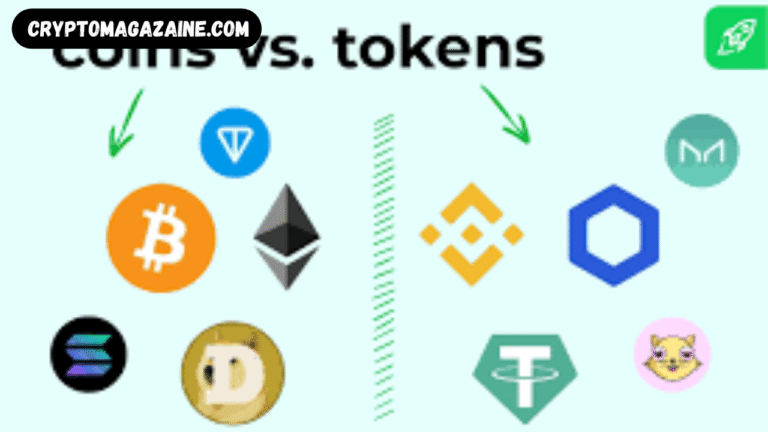
Coins vs. Tokens
Although these terms are often used interchangeably, they differ fundamentally:
- Coins: Native cryptocurrencies of their own blockchains.
- Examples: Bitcoin (BTC) on Bitcoin blockchain, Ether (ETH) on Ethereum blockchain.
- Coins are necessary to pay transaction fees on their respective networks.
- Tokens: Digital assets that exist on top of another blockchain.
- Examples: Aave (AAVE) and Uniswap (UNI), both built on Ethereum.
- Tokens can represent ownership, access, or governance rights within a protocol but rely on a host blockchain for security.
Most of the 10,000+ cryptocurrencies today are tokens, not standalone blockchains.
Blockchain The Technology Behind Crypto

Blockchain is a decentralized ledger where transactions are grouped into blocks, each cryptographically linked to the previous block. This ensures transparency, immutability, and security.
- Nodes: Individual computers that store copies of the blockchain. Bitcoin alone has an estimated 53,000 nodes globally.
- Directed Acyclic Graphs (DAGs): Some networks, such as Avalanche and IOTA, use DAG instead of traditional chains. DAG allows parallel transaction processing and faster throughput.
What Is Decentralization in Crypto?
Decentralization ensures no single entity controls the network. It is commonly evaluated in four areas:
- Data Storage: Multiple nodes store the same ledger.
- Validation: Independent validators approve transactions.
- Management: Governance is community-driven through voting rather than centralized teams.
- Fair Distribution: Tokens are fairly distributed among the community rather than hoarded by early investors.
Not all cryptocurrencies are fully decentralized. Some, like Cardano, are gradually moving toward decentralization in stages, such as its planned Voltaire era.
Altcoins and Their Role
The term altcoin refers to any cryptocurrency other than Bitcoin, including Ethereum, Cardano, and thousands of smaller projects.
- Altcoin Season: A market phase where altcoins outperform Bitcoin in price growth.
- Purpose: Altcoins typically introduce new features, improved scalability, or unique tokenomics.
| Cryptocurrency | Price at Launch | Price (2025) |
|---|---|---|
| Ether (ETH) | $0.74 | $2,375 |
| Cardano (ADA) | $0.02 | $0.52 |
| Binance Coin | $0.15 | $309.99 |
| Solana (SOL) | $0.75 | $104.95 |
| Chainlink (LINK) | $0.11 | $15.62 |
Cryptocurrency Tokens Explained
Utility Tokens
- Purpose: Provide access to a network’s products or services.
- Example: CRV token for Curve Finance incentivizes liquidity providers and serves as a governance token.
Security Tokens
- Purpose: Represent ownership in assets like stocks or real estate.
- Regulation: Subject to oversight by entities like the SEC.
- Example: INX, the first SEC-registered security token, allows tokenized trading of traditional assets on blockchain.
Non-Fungible Tokens (NFTs)
- Purpose: Represent unique assets, often digital art or collectibles.
- Fungibility: Each NFT is unique, unlike utility or security tokens.
Main Types of Cryptocurrency
Bitcoin (BTC)
- Function: Digital gold and store of value.
- Mechanism: Proof-of-Work mining.
- Supply: Capped at 21 million BTC.
Ether (ETH)
- Function: Powers Ethereum’s smart contracts.
- Mechanism: Proof-of-Stake (PoS).
- Features: Smart contracts, dApps, decentralized finance (DeFi).
Binance Coin (BNB)
- Function: Native token of Binance Smart Chain (BSC).
- Features: Lower transaction fees, EVM-compatible.
- Decentralization: Limited, only 56 validators.
Solana (SOL)
- Function: High-speed smart contract network.
- Mechanism: Proof-of-History (PoH).
- Transaction Speed: Up to 65,000 TPS.
Ripple (XRP)
- Function: Cross-border payments.
- Feature: RippleNet enables fast, low-cost transactions.
Cardano (ADA)
- Function: Smart contract platform.
- Unique Feature: Deliberate development with research-based approach.
- Supply Cap: 45 billion ADA.
Dogecoin (DOGE)
- Function: Originally a meme cryptocurrency.
- Mechanism: Fixed yearly issuance of 5 billion coins.
- Notable: Popular community-driven coin.
TRON (TRX)
- Function: Decentralized digital content ecosystem.
- History: Started as an Ethereum token, later became its own blockchain.
Stablecoins (USDT, USDC, DAI)
- Function: Pegged to fiat currencies like USD.
- Examples: Tether (USDT), USD Coin (USDC), DAI (decentralized).
Chainlink (LINK)
- Function: Provides real-world data to smart contracts through decentralized oracles.
- Use Case: Price feeds for DeFi platforms like Aave.
Uniswap (UNI)
- Function: Decentralized exchange (DEX).
- Feature: Governance token for voting on platform changes.
The Future of Cryptocurrency
Cryptocurrency is still in its early stages. While projects like Bitcoin and Ethereum dominate due to network effects, new chains continuously emerge with improvements in scalability, cost efficiency, and user experience.
Key trends include:
- Layer 2 Scaling: Networks like Polygon enhance Ethereum’s speed and reduce transaction costs.
- Decentralized Finance (DeFi): Lending, borrowing, and swapping without intermediaries.
- Tokenization of Assets: Real-world assets represented digitally on blockchain.
- Central Bank Digital Currencies (CBDCs): Governments exploring digital fiat currencies.
The crypto space is volatile, experimental, and dynamic. Investors must research projects thoroughly, understand risks, and never invest funds they cannot afford to lose.
Conclusion
Cryptocurrencies are more than digital money; they are a foundation for a new financial and technological paradigm. From coins like Bitcoin to smart contract platforms like Ethereum, and stablecoins like USDC, the ecosystem offers a variety of ways to interact with blockchain technology.
Innovation in crypto continues to thrive, with open-source collaboration, new consensus mechanisms, and community governance driving development. While predicting the long-term winners is impossible, understanding the differences between coins, tokens, networks, and decentralized applications is crucial for anyone entering this space.
The journey of cryptocurrency is ongoing. Whether as an investment, a technological experiment, or a financial tool, cryptocurrencies are reshaping the way we think about money, value, and trust in the digital age.