Sony Bank, the financial division of global technology group Sony, is reportedly preparing to launch a USD-pegged stablecoin for U.S. customers as early as fiscal 2026, according to a detailed report from Nikkei. This move could reshape how millions of users pay for Sony’s digital services, including gaming, anime, streaming, and online entertainment.
The stablecoin is expected to be issued through Sony’s U.S.-focused crypto subsidiary Connectia Trust and will follow the U.S. GENIUS regulatory framework for stablecoins. If completed, this would position Sony among the first major multinational tech corporations to issue a fully regulated dollar-denominated digital currency specifically designed for consumer payments.
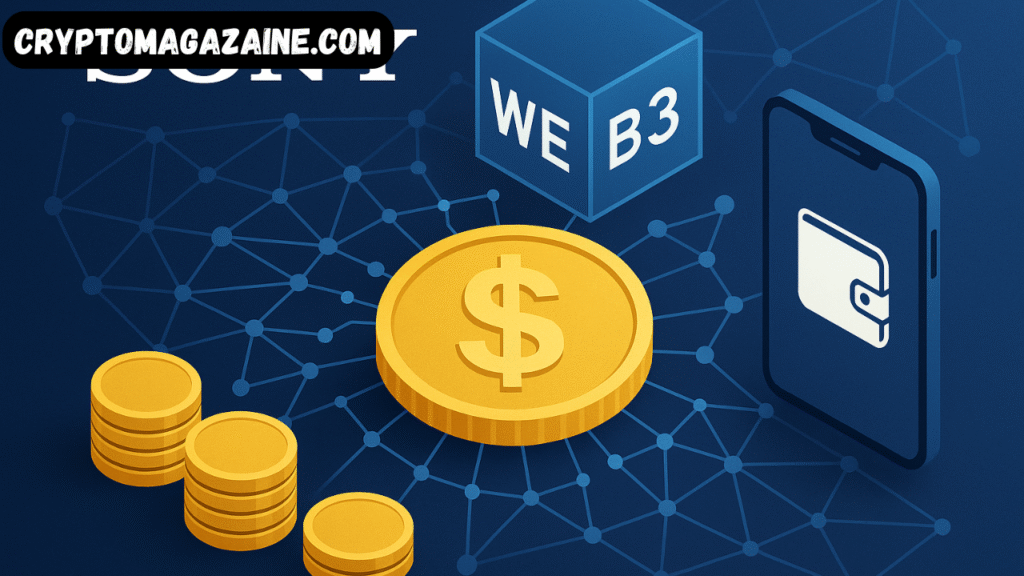
A 1:1 USD-Pegged Digital Currency for Sony’s Digital Ecosystem
Sony’s planned stablecoin will reportedly maintain a 1:1 peg with the U.S. dollar, offering stability and instant settlement capability. The company aims to integrate the stablecoin throughout its entertainment ecosystem, covering:
- PlayStation digital purchases
- PlayStation Plus and cloud gaming subscriptions
- In-game currency and microtransactions
- Anime streaming services such as Crunchyroll
- Digital goods, downloadable content, and cross-platform payments
Currently, most Sony users rely on credit cards, debit cards, and third-party processors for subscription renewals and game purchases. By issuing its own stablecoin, Sony could significantly reduce fee overhead, improve transaction speed, and enhance its control over payment processing.
For a company with hundreds of millions of active entertainment customers worldwide, these optimizations could translate into massive operational savings and new revenue opportunities.
The Strategic OCC Application That Surprised U.S. Regulators
In October, Sony Bank submitted an application to the U.S. Office of the Comptroller of the Currency (OCC) seeking approval to establish a national crypto bank charter under Connectia Trust. The proposal took the U.S. financial sector by surprise, signaling Sony’s intent to become a direct participant in the U.S. banking and digital-assets infrastructure.
If granted a national trust bank charter, Connectia would gain:
- The legal authority to issue a U.S.-regulated stablecoin
- Access to U.S. payment clearing systems
- The ability to provide qualified crypto custody services
- A regulated framework for stablecoin reserve management
- Nationwide operational permission within the United States
This level of financial integration would elevate Sony beyond the role of a service provider and toward a hybrid position as both a digital bank and a global entertainment platform.
Intense Pushback From U.S. Community Banking Groups
However, Sony’s rapid advance into American digital banking has not come without strong resistance. On November 6, the Independent Community Bankers of America (ICBA), one of the most influential banking associations in the United States, sent a sharply worded letter to the OCC strongly opposing Sony Bank’s application.
The ICBA’s key arguments included:
Concerns About Regulatory Arbitrage
The association claimed Sony’s business model appears designed to gain the benefits of a national bank charter without being subject to the full regulatory burden that traditional banks face.
Exceeding the Scope of a Trust Bank
ICBA argued that Connectia Trust’s plan goes well beyond the historical or legal boundaries of what a trust bank is permitted to do.
Threat to the Separation Between Banking and Commerce
U.S. policy has traditionally maintained a strict barrier between commercial enterprises and banking institutions. ICBA believes that granting Sony — a massive tech and entertainment corporation — a bank charter would undermine this separation.
Competitive Disadvantage for Community Banks
Stablecoins backed and issued by large international firms could attract substantial liquidity away from community banks, altering the competitive landscape.
This regulatory objection means Sony must navigate not only financial rules but also political and structural barriers that have shaped the U.S. banking system for decades.
The Global Stablecoin Market Is Surging

Sony’s move comes at a moment when stablecoins are rapidly reshaping global finance. According to the latest data from DeFiLlama:
- The combined market capitalization of the two largest stablecoins, USDT and USDC, exceeds $260 billion.
- The total stablecoin market cap now surpasses $306 billion.
These numbers indicate exploding demand, driven by:
- Cross-border transactions
- Crypto exchange liquidity
- Institutional settlement purposes
- On-chain financial applications
- Dollarization in emerging economies
A recent report from Standard Chartered added further urgency, warning that over $1 trillion could leave emerging-market banking systems and flow into U.S.-dollar stablecoins by 2028. Such a shift would have profound implications for global financial stability, banking liquidity, and U.S. monetary influence.
Sony’s decision to enter this space now shows both strategic timing and acknowledgement of the changing financial landscape.
What Sony’s Stablecoin Could Mean for Gaming and Entertainment
The potential impact of a Sony-issued stablecoin reaches far beyond basic payments. If widely adopted, it could transform digital commerce across Sony’s entire entertainment universe.
New Forms of Digital Ownership
Stablecoin integration could make blockchain-based receipts, licenses, and digital assets easier to manage and verify.
Smoother In-Game Economies
Instead of relying on third-party processors for microtransactions, Sony could create an instant-settlement core for in-game marketplaces.
Unified Payment Layer Across All Sony Platforms
From PlayStation games to anime subscriptions to movie rentals, all could be powered by a single interoperable digital currency.
Reduced Transaction Fees
Stablecoins dramatically reduce payment processing costs compared with legacy credit card networks.
Opportunities in Metaverse and Virtual Experiences
Future virtual worlds, VR spaces, or digital collectibles could be directly monetized through Sony’s own stablecoin, creating a self-contained economic system.
Regulatory Uncertainty Remains the Biggest Barrier
Despite its innovation potential, Sony faces a long regulatory road. The OCC will need to evaluate:
- The stability and safety of Sony’s proposed reserve structure
- Anti-money-laundering and compliance frameworks
- Cybersecurity protections for digital wallets
- Consumer protection and transparency measures
- Banking–commerce separation concerns
- Precedent-setting risks of approving a tech giant for a bank charter
The outcome is far from certain. The ICBA’s opposition alone could prompt heightened scrutiny, delays, or possible rejection. Yet U.S. regulators are also aware that stablecoin innovation is accelerating globally, and they may view Sony as a controlled, reputable entrant into a market that needs stronger guardrails.
Conclusion A High-Stakes Move That Could Redefine Digital Payments
Sony Bank’s planned launch of a U.S.-regulated stablecoin in early 2026 represents one of the boldest moves yet by a major entertainment and technology company. If successful, it could:
- Transform how millions of consumers pay for digital experiences
- Reduce reliance on traditional financial intermediaries
- Expand Sony’s reach into digital banking
- Accelerate mainstream adoption of stablecoins
- Introduce a new model for tech-driven financial ecosystems
However, the project faces strong regulatory headwinds, political resistance from U.S. banking groups, and complex compliance requirements.
The next two years will determine whether Sony becomes a pioneering force in global digital finance — or whether its stablecoin ambitions are slowed by the immense regulatory structure that governs the American banking system.